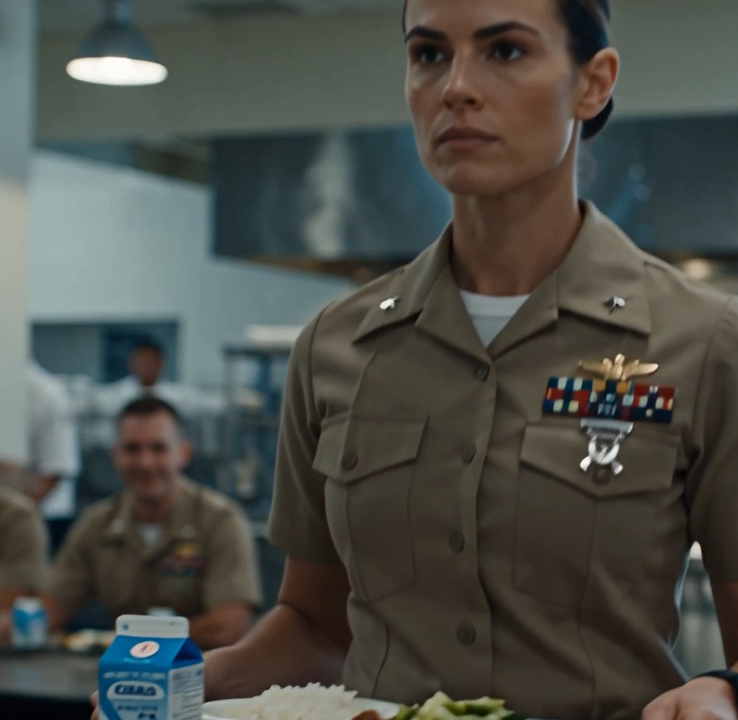
If you came here from Facebook after watching the soldier knock the young woman’s tray to the floor, mock her complaints and suddenly freeze when a senior officer appeared behind her, this is how the story continues.
The cafeteria went completely silent.
The young woman still held the folded complaint in her hand.
The arrogant soldier no longer looked amused.
Behind her, the decorated senior officer took another slow step forward.
The man finally managed to speak.
—Sir… I can explain.
The officer stopped several feet away.
—Good.
—You’re going to have plenty of time to do exactly that.
THE YOUNG WOMAN’S NAME WAS CAPTAIN EMILY CARTER
That was the first detail almost everyone in the room had gotten wrong.
Emily was twenty-seven years old.
She had recently been assigned to the installation after completing a specialized leadership program.
Because she had arrived only days earlier and was wearing a simple duty uniform without drawing attention to herself, many soldiers in the cafeteria did not recognize her.
Marcus certainly didn’t.
MARCUS HAD ASSUMED SHE WAS A JUNIOR SOLDIER
He had seen her entering the cafeteria several times.
Quiet.
Reserved.
Usually alone.
She never mentioned her position.
She never demanded special treatment.
Marcus interpreted that calmness as weakness.
It was a mistake he had made with other people before.
THIS WAS NOT THE FIRST INCIDENT
Emily had already filed two complaints.
The first concerned repeated verbal harassment.
Marcus had made comments about where she should sit, who she should eat with and whether she “belonged” around certain tables.
Emily documented it.
She did not argue with him.
She reported it through the normal internal process.
NOTHING CHANGED
A few days later, Marcus blocked her path in a hallway.
He laughed and asked whether she was still “writing reports.”
That became complaint number two.
Again, Emily documented everything.
Names.
Dates.
Locations.
Witnesses.
Then she waited.
MARCUS THOUGHT THE SILENCE MEANT HE HAD WON
That was why he became bolder.
He started making comments in front of other soldiers.
Some laughed because they thought it was easier than becoming his next target.
Others remained silent.
Emily noticed all of it.
But she never reacted emotionally.
THEN CAME THE CAFETERIA INCIDENT
Emily walked between the tables carrying her meal.
Marcus stepped directly into her path.
Without warning, he knocked the tray sideways with his forearm.
Food hit the floor.
A cup rolled under a nearby chair.
Metal utensils scattered across the tile.
Emily dropped to one knee to catch herself.
SEVERAL SOLDIERS LAUGHED
Marcus looked down at her.
—Wrong table, sweetheart.
Emily said nothing.
He gestured toward the mess.
—What are you gonna do?
—File a complaint?
Emily looked up.
Then she slammed her fist against the hard surface beside her.
The sound cut through the room.
“I ALREADY DID”
Marcus smiled.
Emily stood.
—My third complaint.
He laughed again.
—And you still haven’t figured out that nobody here cares?
He reached across her path.
Emily knocked his arm aside.
THAT WAS WHEN SHE PULLED OUT THE DOCUMENT
Marcus expected another ordinary form.
Instead, Emily unfolded a copy bearing a command-level routing notation.
—The problem is…
She raised it.
—This time I didn’t file it with you.
Marcus’s expression changed before she even finished the sentence.
THE SENIOR OFFICER BEHIND HER WAS COLONEL DAVID HAYES
He had entered the cafeteria only moments earlier.
Emily knew he was there.
Marcus did not.
Colonel Hayes had been reviewing multiple conduct complaints connected to the same unit.
Emily’s third report had not been treated as an isolated disagreement.
It had been compared with earlier reports.
THERE WAS A PATTERN
Marcus had received informal warnings before.
Another soldier had reported being mocked repeatedly.
A junior service member had complained about public intimidation.
One complaint had been withdrawn after the person said they did not want “more trouble.”
That detail interested Colonel Hayes.
HE WANTED TO KNOW WHY PEOPLE WERE AFRAID TO REPORT
That was why he had decided not to confront Marcus immediately.
He wanted supervisors to gather statements first.
He also wanted to observe how Marcus behaved when he believed nobody above him was watching.
The cafeteria answered that question.
“I FILED IT DIRECTLY WITH COMMAND”
Emily said the words without raising her voice.
Marcus turned.
Colonel Hayes was already looking at him.
The laughter in the cafeteria vanished.
Even soldiers who had been smiling seconds earlier suddenly found the floor extremely interesting.
MARCUS TRIED TO EXPLAIN
—Sir, we were joking around.
Colonel Hayes looked at the food on the floor.
Then at Emily.
Then back at Marcus.
—Was she laughing?
Marcus said nothing.
—I asked whether she was laughing.
—No, sir.
“THEN STOP CALLING IT A JOKE”
Colonel Hayes’s voice remained calm.
That made the room feel even quieter.
He instructed Marcus to step away from Emily.
Then he asked the cafeteria supervisor to preserve any available security footage.
Several soldiers exchanged nervous looks.
THE VIDEO WAS CLEAR
Marcus deliberately stepped into Emily’s path.
He knocked the tray away.
He stood over her while other soldiers laughed.
He mocked the complaint process.
Then he physically blocked her again.
There was no ambiguity about the sequence.
EMILY WAS ALSO QUESTIONED
Her status did not exempt her from explaining her own physical reaction.
She admitted immediately that she had forcefully knocked Marcus’s arm away when he blocked her.
—Why?
—Because he had already made physical contact with my tray, was blocking my path again and I wanted space.
She did not exaggerate.
She did not claim he had done things the video did not show.
THAT MATTERED
Colonel Hayes wanted facts.
Not revenge.
Not rumors.
Not a dramatic version of events.
Emily provided exactly what happened.
So did the cameras.
THE BACKGROUND SOLDIERS WERE INTERVIEWED TOO
At first many said they had only seen the cafeteria incident.
Then one admitted:
—He’s done stuff like this before.
Another followed.
—Yeah.
—Just not usually this far.
Colonel Hayes asked a simple question.
—Why did nobody report it?
THE ANSWER WAS UNCOMFORTABLE
One soldier said:
—Because people didn’t want to become his next problem.
Another added:
—And sometimes everyone just laughed so he’d move on.
Emily heard that sentence later.
It bothered her almost as much as Marcus’s behavior.
THE LAUGHTER HAD HELPED HIM
Not because every soldier agreed with him.
Some clearly didn’t.
But each laugh made Marcus believe his behavior was accepted.
Each silent witness made the next incident easier.
Emily had been documenting more than one man’s behavior.
She had been documenting a culture around him.
MARCUS WAS REMOVED FROM HIS NORMAL DUTIES WHILE THE MATTER WAS REVIEWED
The process was formal.
There was no instant theatrical punishment in the cafeteria.
He was given an opportunity to provide his statement.
Prior complaints were reviewed.
Witnesses were interviewed.
Supervisors were questioned about what they knew.
ONE SUPERVISOR HAD A DIFFICULT QUESTION TO ANSWER
Emily’s first complaint had reached him.
He had spoken to Marcus informally.
But he had never documented the conversation properly.
He had assumed the issue would disappear.
It didn’t.
That failure also became part of the review.
EMILY WAS ASKED WHY SHE KEPT REPORTING
Her answer was straightforward.
—Because if I stop after the first time nothing happens, then the system only works for people who are willing to keep fighting it.
Colonel Hayes nodded.
—And not everyone can.
—Exactly.
HER RANK WAS REVEALED TO THE CAFETERIA AFTERWARD
That created another problem.
Suddenly several soldiers who had barely acknowledged Emily before became unusually respectful.
Some called her “ma’am” with exaggerated nervousness.
Others apologized immediately.
Emily noticed.
SHE CALLED THE UNIT TOGETHER
Not to embarrass them.
To make a point.
—Some of you are treating me differently today.
No one answered.
—Why?
A soldier finally said:
—Because we know who you are now, ma’am.
EMILY SHOOK HER HEAD
—That is exactly the wrong answer.
The room remained silent.
—If you only respect somebody after learning their rank, you didn’t learn anything from what happened.
Several soldiers looked uncomfortable.
That was intentional.
“YOU SHOULD HAVE RESPECTED ME WHEN YOU THOUGHT I HAD NOTHING TO OFFER YOU”
Emily continued:
—And you should respect the next person who walks into this room whether they’re junior to you, senior to you or completely outside your chain of command.
That message spread quickly.
MARCUS EVENTUALLY FACED FORMAL CONSEQUENCES
The exact outcome was determined through the applicable disciplinary process.
His repeated conduct mattered.
So did the physical cafeteria incident.
So did the previous complaints.
And so did evidence that earlier warnings had failed to change his behavior.
MONTHS LATER, MARCUS REQUESTED A MEETING WITH EMILY
She agreed only after confirming it could occur professionally and with another person nearby.
Marcus looked very different from the man who had stood over her in the cafeteria.
He sat down.
—I owe you an apology.
Emily waited.
“FOR WHICH PART?”
Marcus took a breath.
—For the tray.
—For the comments.
—For thinking the complaints didn’t matter.
Emily asked:
—Why did you think they didn’t matter?
MARCUS ANSWERED MORE HONESTLY THAN SHE EXPECTED
—Because nothing happened the first two times.
Emily nodded.
—So you thought that meant I was powerless.
—Yeah.
—And if Command had never seen the third complaint?
Marcus looked down.
—I probably would have kept doing it.
THAT WAS THE ANSWER EMILY WANTED HIM TO UNDERSTAND
—Then don’t apologize because you finally got caught by somebody important.
—Apologize because you understand why it was wrong when you believed nobody important was watching.
Marcus sat quietly.
Then nodded.
“THAT’S FAIR”
Emily accepted the apology.
That did not erase the process.
It did not restore trust automatically.
And it did not make them friends.
But it was the first conversation in which Marcus appeared to understand the actual issue.
THE CAFETERIA CHANGED TOO
Not because someone installed a new rule saying “don’t knock over trays.”
The change was broader.
Supervisors became more serious about documenting repeated conduct.
Soldiers were reminded that “joking” does not automatically make behavior acceptable.
Reporting channels were clarified.
And retaliation concerns were addressed more directly.
EMILY CONTINUED EATING IN THE SAME CAFETERIA
At the same tables.
In the same uniform.
She did not suddenly isolate herself with senior officers.
One afternoon a young soldier asked:
—Ma’am, why do you still sit out here?
Emily replied:
—Because this is a cafeteria.
—Not a throne room.
THE SOLDIER LAUGHED
This time Emily laughed too.
That difference mattered.
The humor was shared.
Not aimed downward at somebody who was already being humiliated.
EVERYTHING HAD STARTED WITH A TRAY
Emily walked between the tables.
Marcus stepped in front of her.
His forearm knocked the tray sideways.
Food hit the floor.
Soldiers laughed.
He looked down and said:
—Wrong table, sweetheart.
THEN HE MOCKED THE ONE THING THAT WOULD CHANGE EVERYTHING
—What are you gonna do?
—File a complaint?
Emily looked up.
—I already did.
She stood.
—My third complaint.
MARCUS STILL THOUGHT HE WAS SAFE
—Nobody here cares.
Then he blocked her again.
Emily knocked his arm aside.
Pulled out the document.
And said:
—This time I didn’t file it with you.
SECONDS LATER HE SAW COLONEL HAYES
The laughter disappeared.
The room went silent.
Emily raised the document.
—I filed it directly with Command.
That was the moment Marcus finally understood that the complaints he had mocked had not disappeared.
BUT THE REAL LESSON WASN’T THAT EMILY HAD ACCESS TO A SENIOR OFFICER
It was that she should never have needed that reveal to be treated properly.
Her complaint mattered before Colonel Hayes walked into the room.
Her dignity mattered before anyone learned her rank.
And the behavior was wrong even when Marcus believed nobody with authority was watching.
That was what changed the cafeteria.
Not fear of one senior officer.
The realization that silence, laughter and ignored complaints had allowed the problem to grow.