If you came here after watching a much larger soldier challenge a smaller woman, throw two kicks at her and end up balancing on one leg while she calmly held the other, this is how the story continues.
The training yard went silent.
The tall soldier was still balancing awkwardly on one boot.
His other leg remained locked across the woman’s arms.
Seconds earlier, he had been laughing at her size.
Now his expression had completely changed.
—Who the hell are you?
The woman did not release his leg.
Her breathing remained steady.
—The person your commander warned you never to underestimate.
She looked directly into his eyes.
—Still think I’m too small?
HIS NAME WAS SERGEANT COLE HARRIS
Cole was thirty-four years old.
Tall.
Powerful.
Experienced.
And very aware of how physically intimidating he looked beside most people.
That confidence had served him well during training.
But over time, confidence had turned into something else.
He had started believing that size alone decided who belonged in a difficult position.
THE WOMAN WAS CAPTAIN MAYA TORRES
Twenty-eight years old.
Shorter than almost every man in the circle.
Lean rather than bulky.
Quiet.
Disciplined.
She had arrived at the training installation only three days earlier.
Most of the soldiers knew almost nothing about her.
THAT WAS NOT AN ACCIDENT
Maya had been assigned to observe a new close-combat and field-readiness program.
Her job was not simply to participate.
She was there to evaluate how the unit trained under stress.
She also had authority to recommend changes before the program expanded.
The commander knew exactly who she was.
Cole did not.
THE COMMANDER HAD GIVEN ONE WARNING
Earlier that morning, Lieutenant Colonel Grant had spoken briefly with the group.
—You’ll have an evaluator joining training today.
One soldier asked:
—Who?
Grant responded:
—You’ll know when you need to.
Then he added one sentence:
—Don’t underestimate anyone in this yard.
COLE HAD LAUGHED
He assumed the commander was giving another generic speech about discipline.
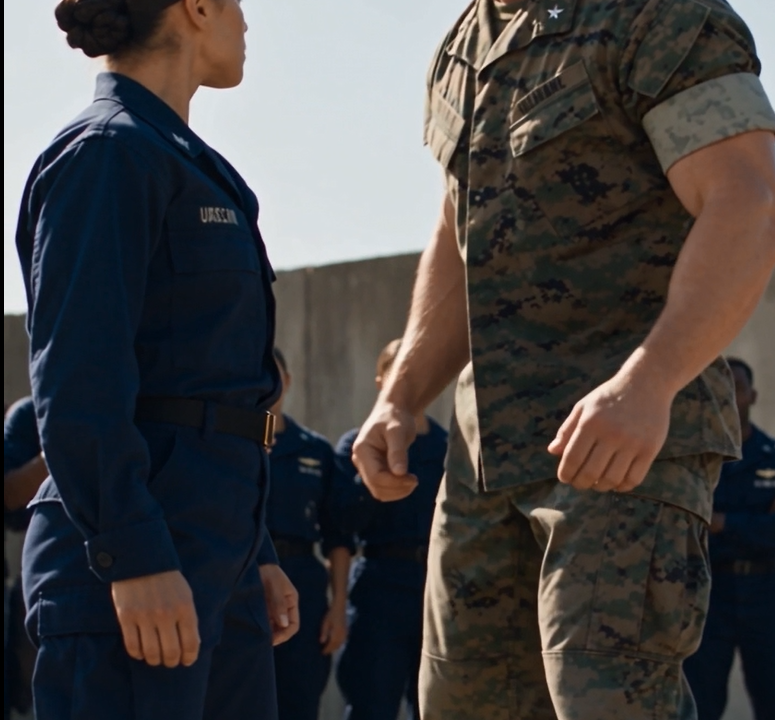
Then Maya entered the circle.
Dark blue training uniform.
Hair secured tightly.
No dramatic introduction.
No display of rank.
Cole looked her up and down.
And immediately made a decision about her.
“SHE’S HALF MY SIZE”
He said it to another soldier quietly.
But Maya heard him.
She did not react.
The exercise began.
Instead of treating it as controlled training, Cole tried to dominate the exchange immediately.
He stepped forward.
Threw the first kick.
And warned her to move.
MAYA AVOIDED THE CLEAN IMPACT
She did not counterattack.
She simply repositioned herself.
That should have been enough.
Instead, Cole took her restraint as weakness.
—You really think you belong in this ring with me?
He smiled.
—Look at you.
—You’re half my size.
MAYA FINALLY ANSWERED
—Size doesn’t scare me.
Cole’s smile remained.
Then she added:
—Weak men hiding behind size do.
The soldiers around them reacted instantly.
That was when Cole lost discipline.
THE SECOND KICK WAS NOT PART OF THE PLAN
It came faster.
Harder.
More emotional.
Cole was no longer trying to demonstrate technique.
He was trying to prove a point.
Maya saw it immediately.
SHE CAUGHT HIS LEG CLEANLY
Both arms secured his lower leg before the strike reached her body.
Cole’s eyes widened.
—What the hell—?
He pulled backward.
Nothing.
Maya adjusted her grip.
He remained trapped.
FOR THE FIRST TIME, HIS SIZE WORKED AGAINST HIM
His entire body was now balanced on one leg.
The more aggressively he tried to pull away, the less stable he became.
Maya did not need to overpower his entire body.
She only needed to control his balance.
That was the lesson Cole had missed.
THE CROWD UNDERSTOOD BEFORE HE DID
Several soldiers were still recording.
One whispered:
—She caught him clean.
Another answered:
—He’s in trouble.
Cole heard them.
That embarrassed him even more.
“LET GO OF MY LEG”
Maya remained silent.
Cole pulled again.
—I said let go!
Nothing changed.
Then Maya spoke.
—Five seconds ago you were laughing.
She tightened her control slightly.
—Why aren’t you laughing now?
COLE TRIED TO RECOVER HIS AUTHORITY
—You have no idea who you’re embarrassing.
Maya looked directly at him.
He continued:
—Put my leg down before you regret this.
She did not blink.
—Wrong question.
Then came the line that changed everything.
—Do you know who you just challenged?
THE COMMANDER ENTERED THE CIRCLE
Lieutenant Colonel Grant had been watching from the edge of the yard.
He stepped forward.
—Captain Torres.
Cole froze.
His eyes moved from Maya to the commander.
—Captain?
MAYA FINALLY RELEASED HIS LEG
But she did it carefully.
She lowered his boot back to the ground instead of throwing him.
Cole took one step backward.
He no longer looked angry.
He looked confused.
GRANT FACED THE ENTIRE GROUP
—Captain Maya Torres is not here to prove she can beat anyone up.
Maya remained silent beside him.
Grant continued:
—She is here because she helped design the evaluation standards you’re training under.
Cole’s expression dropped further.
MAYA HAD YEARS OF SPECIALIZED TRAINING
Not because she was stronger than everyone.
Because she understood leverage.
Timing.
Balance.
Movement.
And how to stay calm when somebody else became emotional.
Those were the skills the program was supposed to teach.
COLE HAD DEMONSTRATED THE OPPOSITE
He had relied on intimidation.
Lost discipline after being challenged verbally.
And thrown a second strike because his ego was hurt.
Grant looked at him.
—You want to know why she was able to control you?
Cole remained quiet.
—Because you stopped thinking.
NOBODY LAUGHED THIS TIME
Grant looked around the circle.
—Put the phones down.
Several soldiers immediately lowered them.
—This is training.
—Not a humiliation show.
That sentence mattered to Maya.
SHE DID NOT WANT COLE TURNED INTO A JOKE
She stepped forward.
—Sergeant Harris.
Cole looked at her.
—Yes, ma’am.
—Why did you throw the second kick?
He hesitated.
—Because you challenged me.
Maya shook her head.
“NO”
—I answered you.
—You challenged yourself.
Cole looked away.
Maya continued:
—You decided somebody smaller couldn’t embarrass you.
—Then you got emotional trying to prove it.
—That’s exactly when technique beats strength.
COLE DID NOT ARGUE
For the first time that morning, he listened.
Grant asked:
—Do you understand the failure?
Cole nodded.
—Yes, sir.
—Say it.
COLE TOOK A BREATH
—I underestimated her.
Grant remained expressionless.
—That’s part of it.
Cole looked at Maya.
—I let my ego control the exchange.
Maya nodded.
—Better.
THE TRAINING DID NOT END THERE
Grant ordered everyone back into position.
Cole expected to be removed from the exercise.
Instead Maya said:
—Again.
He looked surprised.
—With you?
—Yes.
THIS TIME THE RULES WERE CLEAR
Controlled movement.
No unnecessary force.
No attempts to prove anything.
Technique only.
Cole nodded.
They reset.
THE SECOND EXCHANGE LOOKED COMPLETELY DIFFERENT
Cole did not rush forward.
He watched her feet.
Maya tested his positioning.
He adjusted.
She moved again.
Neither person tried to dominate through intimidation.
It looked like training instead of a fight.
MAYA STOPPED AFTER THIRTY SECONDS
—Better.
Cole almost looked surprised by the compliment.
—Thank you, ma’am.
—Don’t thank me.
She pointed toward his stance.
—Fix your balance.
He did.
THE VIDEO STILL EXISTED
Several soldiers had recorded the first confrontation.
By that evening, a short clip had already begun circulating privately.
The clip showed Cole throwing the kick.
Maya catching it.
And him demanding she let go.
It did not show what happened afterward.
MAYA ASKED THAT IT NOT BE USED TO HUMILIATE HIM
One soldier asked:
—Why?
—He started it.
Maya responded:
—Because if the lesson becomes “look how stupid Harris looks,” then nobody learns anything.
She paused.
—The lesson is why he lost control.
COLE HEARD ABOUT THAT
It surprised him.
He had assumed Maya would enjoy what happened.
Instead, she protected the training environment.
A few days later he approached her alone.
“CAPTAIN”
Maya looked up from a clipboard.
—Sergeant.
Cole stood awkwardly for a moment.
—I owe you an apology.
—For which part?
He almost smiled.
—Fair question.
HE ANSWERED SERIOUSLY
—For talking to you like you didn’t belong there.
—And for letting it get personal.
Maya nodded.
—Accepted.
Cole seemed relieved.
Then she added:
—Now don’t do it to the next person.
THAT WAS THE PART THAT STAYED WITH HIM
A few weeks later, a new group arrived for training.
One of the smallest soldiers struggled during the first exercise.
Another man laughed.
Cole immediately stopped him.
—Don’t.
The soldier looked confused.
—Don’t what?
—Decide what somebody can do by looking at them.
THE OTHERS LOOKED AT COLE
One of them smiled.
—Speaking from experience?
Cole sighed.
—Unfortunately.
The group laughed.
This time Cole laughed too.
HE COULD FINALLY LAUGH BECAUSE HE HAD LEARNED THE LESSON
Months earlier, being embarrassed would have made him angry.
Now he could admit when he had been wrong.
That change mattered more than winning any training exchange.
MAYA’S ROLE ALSO BECAME CLEARER
She was not there because commanders believed smaller soldiers needed special treatment.
It was the opposite.
Her job was to prove that effective training had to prepare people for unpredictable opponents.
Different sizes.
Different styles.
Different strengths.
REAL CONFRONTATIONS DO NOT ARRIVE IN MATCHING WEIGHT CLASSES
That was one of the central ideas behind the program.
A strong person needed technique.
A smaller person needed technique.
Everyone needed discipline.
Because uncontrolled aggression could turn any physical advantage into a weakness.
COLE BECAME ONE OF MAYA’S BEST STUDENTS
Not immediately.
He still relied too much on power.
He still became impatient.
But he improved.
And unlike before, he started asking questions.
ONE DAY HE ASKED HER THE QUESTION EVERYONE WANTED ANSWERED
—How did you know you could catch that kick?
Maya responded:
—I didn’t.
Cole frowned.
—What?
—I knew where your balance was going.
—That’s different.
SHE EXPLAINED
His first kick had told her almost everything.
Where he placed his supporting foot.
How high he lifted the knee.
How he shifted his shoulders before committing.
And how much he relied on forward power.
When he threw the second kick angrily, those signals became even more obvious.
“SO I TELEGRAPHED IT?”
Maya nodded.
—Badly.
Cole shook his head.
—That hurts more than getting caught.
Maya smiled for the first time.
—Good.
—You’ll remember it.
HE DID
Months later, Cole was teaching younger soldiers.
One recruit was much stronger than his partner.
He began becoming careless.
Cole stopped the drill.
—Strength is useful.
—Arrogance isn’t.
SOMEONE ASKED WHERE HE LEARNED THAT
Cole looked toward Maya, who was standing across the yard.
—The hard way.
Maya heard him.
She said nothing.
But she gave a small nod.
THE INCIDENT BECAME PART OF THE TRAINING CULTURE
Not as a story about a woman humiliating a larger man.
That interpretation was too shallow.
It became a story about assumptions.
About discipline.
And about how quickly ego could destroy good technique.
THE ORIGINAL MOMENT LASTED ONLY SECONDS
Cole stepped forward.
—Move.
—Before I make you move.
Maya stood her ground.
He mocked her size.
She answered calmly.
He lost his temper.
THEN CAME THE SECOND KICK
Maya intercepted it.
Cole pulled.
She kept control.
—Let go of my leg.
She didn’t.
—I said let go!
MAYA LOOKED STRAIGHT AT HIM
—Five seconds ago you were laughing.
—Why aren’t you laughing now?
Cole tried one last threat.
—You have no idea who you’re embarrassing.
Maya answered:
—Wrong question.
THEN SHE ASKED THE ONE QUESTION HE COULD NOT ANSWER
—Do you know who you just challenged?
Cole finally asked:
—Who the hell are you?
And the answer changed the entire meaning of the confrontation.
She was not a random recruit.
She was Captain Maya Torres.
The evaluator his commander had warned them about.
BUT HER RANK WAS NOT THE REAL LESSON
Cole should not have respected her only after discovering she was a captain.
He should have respected her before knowing anything about her rank.
Her uniform.
Her size.
Her appearance.
None of those things told him how capable she was.
AND MAYA NEVER NEEDED TO HUMILIATE HIM TO PROVE IT
She controlled the exchange.
Lowered his leg safely.
Allowed him to train again.
Accepted his apology.
And eventually helped him become better.
That was why the commander trusted her.
Not because she could dominate someone larger.
Because she could remain disciplined when the other person could not.